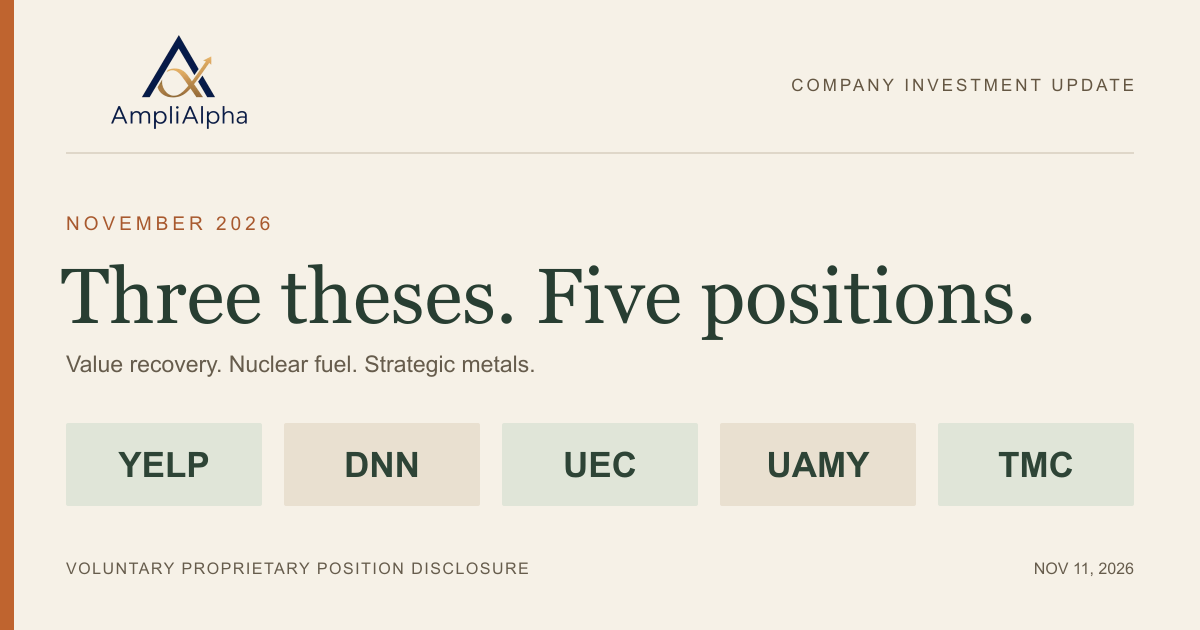
Low-priced earnings. Nuclear fuel. Strategic metals after a reset. Three theses behind five November investments.
Our November investments follow three ideas: buy earnings that we believe are priced too cheaply, own the fuel supply behind the nuclear-energy theme, and enter strategic-metals positions after a sharp reset in expectations. YELP, DNN, UEC, UAMY, and TMC express those ideas in different ways.
AmpliAlpha has invested company-owned capital in all five this month. The timing matters: Yelp is showing price action that strengthens our valuation case, while the upcoming UAMY and TMC results give us a near-term test of whether their selloffs have gone too far.
YELP: low-priced earnings, with the chart starting to agree
We bought Yelp because we believe its earnings are priced too cheaply, and our reading of the chart is that its recent base is complete. The combination matters. A low P/E can persist for years; improving price action gives us a reason to act on the valuation now.
At the November 10 close of $20.15, public market data showed a trailing P/E of approximately 9.6 times. Yelp rose 2.91% that day after a volatile earnings week. We see the recent recovery as constructive evidence for our base-completion thesis, rather than proof that every subsequent session will be positive.
There are real earnings underneath that multiple. Yelp reported approximately $35 million of net income on $371 million of revenue for Q3 2026. Revenue was down 1% year over year, and net income also declined. Our case therefore rests on the market being too pessimistic about the durability of those earnings: stabilization could justify a higher multiple without requiring extraordinary growth.
The opportunity is a potential valuation recovery supported by a stronger chart. Renewed earnings deterioration or a decisive failure of the recent base would weaken that case.
DNN + UEC: two positions in the nuclear-fuel thesis
DNN and UEC belong together in our investment logic. Nuclear power requires a reliable fuel supply, and we want exposure to the uranium needed to support it. Our thesis is that sustained demand for nuclear generation can increase the value of credible uranium production and development assets.
Denison gives us exposure to a major Canadian development project moving toward production. Its November 4 update estimated Phoenix at 24% total completion as of September 30 and maintained a target of first production in the second half of 2028. That gives the investment a concrete set of milestones: construction progress, spending, and delivery against the schedule.
UEC adds the U.S. supply-chain side through its Wyoming and South Texas in-situ recovery platforms. Together, the two holdings express our conviction in nuclear fuel through different assets and operating stages: Canadian development potential alongside U.S. production capacity.
These are two directional exposures to the same theme, so their risks can move together. The thesis needs support from uranium economics and company execution; enthusiasm for nuclear energy alone will not build a mine or produce profitable pounds.
UAMY + TMC: buying the pullback before the next test
Our entry into UAMY and TMC follows substantial share-price drawdowns. We see an opportunity in the gap between depressed market expectations and the strategic importance of secure mineral supply. The upcoming financial and operating updates are a reason to revisit that gap now.
The defense connection is most direct at UAMY: antimony supply includes deliveries to the U.S. Defense Logistics Agency. For this investment, the useful questions are how much material is shipped, what margins those deliveries generate, and how reliably feedstock and processing capacity support further orders. The value of the defense theme ultimately has to appear in operating results.
TMC gives us broader exposure to critical metals used in defense, energy, and industrial supply chains. Its investment case depends on advancing a mineral resource into a viable commercial operation. We will look for evidence on regulatory progress, processing and commercialization plans, funding needs, and cash runway. Those developments matter more to our thesis than an isolated quarterly EPS figure.
Both companies have scheduled updates for November 12, 2026: UAMY at 4:15 p.m. ET and TMC at 4:30 p.m. ET. We entered ahead of that window because we believe the pullbacks have created a more attractive setup. Evidence of operating progress could help rebuild confidence; delays, weak economics, or greater financing pressure could justify continued weakness.
What connects the five investments
The common thread is the relationship between price, expectations, and the next piece of evidence. In Yelp, we see a low earnings multiple meeting an improving technical setup. In DNN and UEC, we see two ways to own the nuclear-fuel theme. In UAMY and TMC, we see a chance to enter strategically relevant materials after a deep pullback and before a defined reporting event.
These are our investment judgments as of November 11, 2026. We will assess them against earnings, project execution, and price behavior. Entry prices, position sizes, and returns are not disclosed; the market prices cited above are reference data, not AmpliAlpha execution prices.
Company releases and market data support the factual references. Investment theses and technical interpretations are AmpliAlpha’s views.
- Yelp: Q3 2026 results, November 5
- YELP: valuation snapshot (trailing P/E), November 10
- YELP: daily price history through November 10
- Denison: Q3 2026 results and Phoenix construction progress
- UEC: U.S. uranium production platforms
- UAMY: September 30 update on DLA shipments
- UAMY: November 12 results and webcast announcement
- TMC: November 12 results and corporate update announcement
- UAMY: historical share prices
- TMC: November 10 price and 52-week range
About AmpliAlpha
AmpliAlpha is a research-driven quantitative finance company combining proprietary trading, trading technology products, institutional infrastructure, and applied quant education.
Media contact: [email protected]
Published November 11, 2026; updated the same day with AmpliAlpha’s investment rationale. Market references use information available through November 10. The November 12 events were still upcoming at publication. This is a voluntary, unaudited disclosure of selected investments made with company-owned capital, not a complete portfolio or performance report.
This article expresses AmpliAlpha’s investment views and is not investment advice, an offer, or a solicitation to buy or sell any security. AmpliAlpha holds financial interests in the securities discussed and may change or close positions without notice. Technical interpretations and investment theses may be wrong. Earnings events, commodity prices, regulatory decisions, and financing needs can cause substantial losses, including loss of principal.