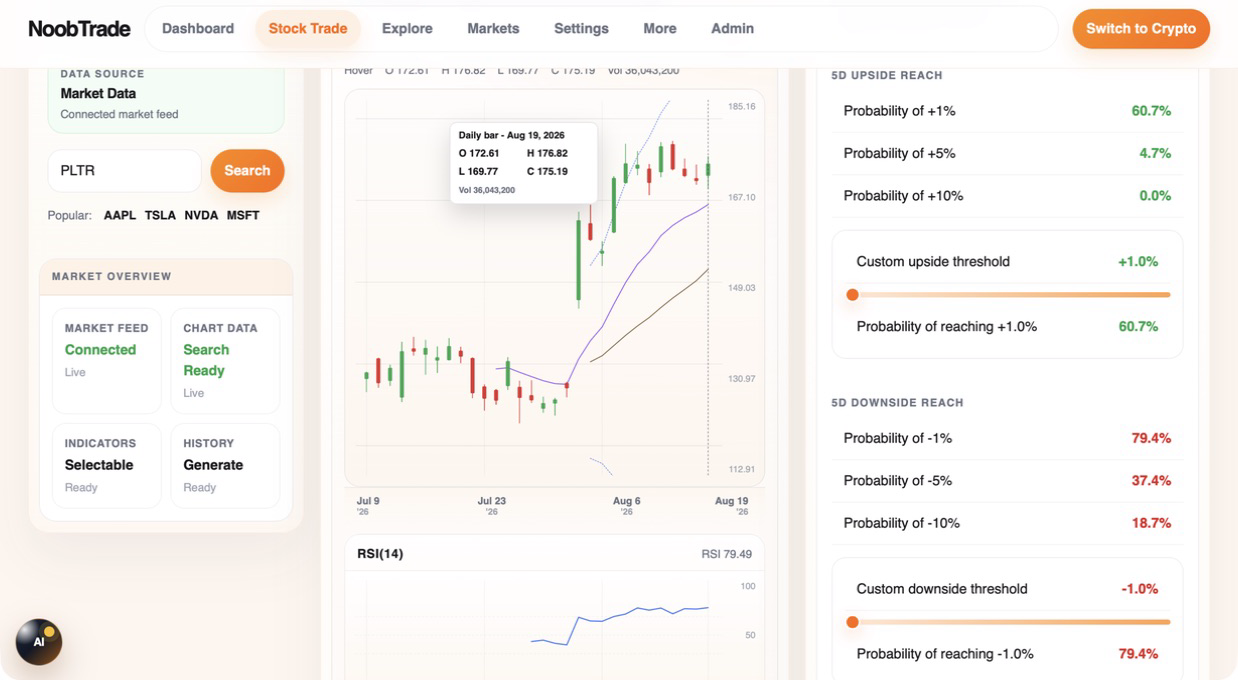
AmpliAlpha initiated a short position in Palantir Technologies at an average entry price of approximately $175 per share and has established a working downside scenario near $135. During the same quarter, the company increased its long exposure to PDD Holdings. Both decisions were made in AmpliAlpha's proprietary account; position sizes are not disclosed.
This is a voluntary company communication, not an SEC filing, an audited performance report, or a recommendation for another investor. AmpliAlpha may reduce, close, hedge, or reverse either position as facts, price, liquidity, borrow conditions, or risk limits change.
Why Palantir's execution is not the issue
Palantir's operating momentum is exceptional. Its Q2 2026 business update reported $1.94 billion of revenue, up 93% year over year, with U.S. commercial revenue up 149% and U.S. government revenue up 90%. The company also reported a 62% adjusted operating margin and $1.22 billion of adjusted free cash flow.
Our short thesis does not depend on denying that growth. It depends on the price already demanding an unusually long period of extraordinary execution. At approximately $175.19, public market data placed PLTR near 150 times trailing earnings. Strong growth can coexist with an unattractive risk-reward when expectations leave little room for normalization.
The valuation burden
The shorthand claim that Palantir must grow above 40% for ten years is too blunt, because the answer changes with the earnings base, margins, terminal multiple, dilution, and discount rate. A transparent scenario is more useful: starting from approximately $1.17 of trailing earnings per share, assuming 40% annual EPS growth, a 30-times terminal multiple, and a 10% required return, the current price requires roughly six years of compounding near that pace. Lower growth or faster multiple compression materially reduces the present value.
Our $135 scenario represents roughly 23% downside from the disclosed entry area. It is intended to capture a partial normalization of the valuation premium, not a collapse of Palantir's business. Continued upside surprises, durable margins, major contract wins, or renewed multiple expansion could invalidate the scenario and force the position to be covered.
Palantir can remain an exceptional company while its stock offers an unattractive risk-reward at approximately 150 times trailing earnings.
What NoobTrade showed at entry
At the time of this disclosure, NoobTrade compared PLTR's daily setup with 20 similar historical patterns and classified the result as Bearish Bias. Its similarity-weighted five-day touch frequencies were 79.4% for -1%, 37.4% for -5%, and 18.7% for -10%. The corresponding upside touch frequencies were 60.7% for +1%, 4.7% for +5%, and 0.0% for +10%.
These figures are historical touch frequencies, not mutually exclusive outcomes and not forecasts. A single five-day path can touch both an upside and downside threshold. The output is supporting evidence within a broader research process; it is not the sole basis for the position.
Why AmpliAlpha increased PDD
The PDD increase represents a separate long thesis rather than a direct pair trade against PLTR. We see a different balance between operating uncertainty and embedded expectations: PDD carries material China, competition, regulation, and margin risks, but its market price does not require the same duration of premium growth implied by PLTR's valuation.
AmpliAlpha is not publishing a PDD price target or position size in this note. The purpose is to disclose the quarter's directional change while preserving the company's execution process and risk limits.
How these disclosures will work
AmpliAlpha will publish voluntary position notes when a proprietary decision is sufficiently material or instructive to warrant public context, and may summarize selected activity in periodic company reviews. We do not intend to publish a daily trade blotter or disclose every position.
Mandatory Form 13F reporting, where applicable, is quarterly and generally covers certain long U.S. equity positions rather than short stock positions. This note is deliberately labeled as a voluntary proprietary position disclosure and should not be confused with regulatory reporting.